
SS-520
| Status | Active |
|---|---|
| Country | Japan |
| Manufacturer | IHI Corporation |
| Number of orbital launches | 2 |
| First launch | 2017-01-14 |
| Last launch | 2018-02-03 |
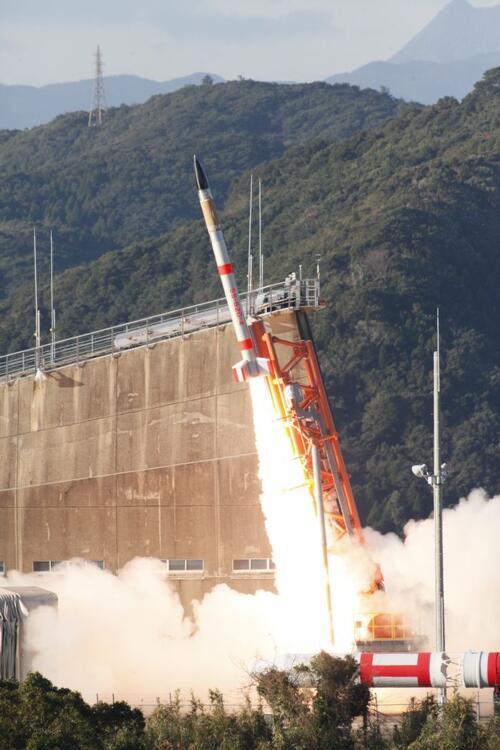
The smallest orbital launch capable rocket. The SS-520 booster is based on the SS-520 sounding rocket, a two-stage vehicle developed by IHI Aerospace and JAXA’s Institute of Space and Astronautical Science.
Launches:
| Launch date | Launch site | Rocket / Variant | Mission / Payload | Notes | Status |
|---|---|---|---|---|---|
| 2018-02-03 | Kagoshima | SS-520 3 stage | Tricom 1R | success | |
The smallest rocket to ever put an object in orbit around Earth. | |||||
| 2017-01-14 | Kagoshima | SS-520 3 stage | Tricom 1 | failure | |
Telemetry lost after first stage burn, around 20 seconds after liftoff. Problem traced to a power supply failure in the rocket’s telemetry and command system, which was likely caused by a damaged wire that caused a short circuit. | |||||
Variants:
(This section is under construction)SS-520 3 stage
| First launch | 2017-01-14 |
|---|---|
| Stages | 3 |
| Mass | 2.9 t |
| Height | 9.54 m |
| Diameter | 0.52 m |
Payload capacity:
| LEO | 4 kg to 180 x 1,500km / 31 deg |
|---|
A third stage was added on top of the base suborbital variant to give it the capability to reach orbital speeds of more than 17,000 mph (27,000 kilometers per hour).
SS-520 2 stage
| Stages | 2 |
|---|
The basic SS-520 sounding rocket is designed to propel more than 300 pounds (140 kilograms) of science research instrumentation to an altitude of nearly 500 miles (800 kilometers) for a few minutes of exposure to space before falling back to Earth. It has no orbital capability